
Introduction
Teleportation has always lived somewhere between fantasy and cutting-edge science. The concept of immediately shifting matter from one location to another continues to pique both curiosity and skepticism in everything from science fiction movies to theoretical physics articles. Discussions about an Apple teleport machine, a hypothetical device that blends cutting-edge quantum mechanics with the engineering philosophies of businesses like Apple Inc., have given the idea a more contemporary spin recently.
But here’s where things get interesting: teleportation isn’t entirely fiction anymore. Quantum teleportation already exists—just not in the way most people think. Instead of transporting physical objects, it transmits quantum states. That distinction changes everything.
So the real question behind “Quantum Mechanics and the Apple Teleport Machine: Is It Technologically Possible?” isn’t just philosophical—it’s deeply technical. Can current or near-future technology bridge the gap between quantum data transfer and full-scale physical teleportation? And if a company like Apple were to attempt it, what would the architecture even look like?
Let’s break it down like engineers, not dreamers.
What Is Quantum Mechanics and the Apple Teleport Machine: Is It Technologically Possible?
Fundamentally, this subject lies at the nexus of advanced system engineering, information theory, and quantum physics.
Quantum Mechanics: The Foundation
Quantum mechanics governs how particles behave at extremely small scales—atoms, electrons, photons. It introduces non-intuitive concepts like:
- Superposition (a particle existing in multiple states simultaneously)
- Entanglement (two particles sharing a linked state regardless of distance)
- Wavefunction collapse (measurement defining reality)
These aren’t just theoretical—they’re experimentally verified.
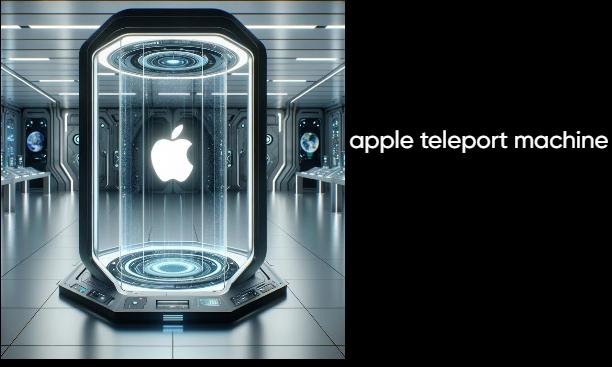
The Apple Teleport Machine Concept
The apple teleport machine is a conceptual system that applies these quantum principles to achieve:
- State capture of an object at atomic resolution
- Transmission of that state across space
- Reconstruction of the object at a destination
Think of it less like “moving matter” and more like:
Destroy → Encode → Transmit → Rebuild
That’s not science fiction—it’s a logical extension of quantum teleportation principles.
Why This Concept Exists
From a systems perspective, teleportation solves a massive problem:
- Eliminating latency in physical transport
- Removing dependency on infrastructure (roads, planes, fuel)
- Enabling instantaneous global or even interplanetary movement
But solving that problem requires rethinking what “movement” actually means.
How It Works (Deep Technical Explanation)
Let’s treat the apple teleport machine as a distributed system—because that’s essentially what it would be.
Step 1: Atomic State Mapping
Before anything can be transmitted, the system must:
- Scan the object at quantum resolution
- Capture position, spin, momentum, and energy states of all particles
This is not trivial.
A human body contains roughly 7 × 10²⁷ atoms. Capturing that data would require:
- Exabyte to zettabyte-scale storage
- Quantum-level sensors
- Non-destructive measurement (which is currently impossible)
Here’s the first hard limitation: Measurement alters quantum states.
So the act of scanning already breaks the original system.
Step 2: Quantum Encoding
Once captured (hypothetically), the state must be encoded into a transferable format.
This is where quantum information theory comes in:
- Classical bits (0,1) are insufficient
- You need qubits, capable of superposition
The encoding process would involve:
- Mapping atomic states into quantum circuits
- Compressing redundant data
- Maintaining entanglement fidelity
In practice, this resembles:
- Quantum serialization
- State vector encoding
- Error-corrected quantum memory
Step 3: Transmission via Quantum Channels
Quantum teleportation today works using:
- Entangled particle pairs
- Classical communication channels
The process:
- Two locations share entangled particles
- Sender performs a measurement
- Receiver applies transformation using classical data
Important: No matter is transferred—only state information.
For an apple teleport machine, this process would need to scale from:
- Single photons → trillions of particles
That’s a massive jump in complexity.
Step 4: Reconstruction Engine
At the destination:
- A reconstruction system would assemble atoms
- Apply the transmitted quantum state
- Rebuild the original structure
This requires:
- Atomic-level fabrication (beyond current nanotech)
- Perfect synchronization of quantum states
- Massive energy input
This is where teleportation becomes less like networking—and more like matter compilation.
Core Components
If we imagine building an apple teleport system, its architecture might look like this:
Quantum Scanner Layer
This layer acts like an ultra-advanced sensor array:
- Uses quantum tomography techniques
- Captures probabilistic state distributions
- Interfaces with quantum processors
The challenge: You cannot measure without collapsing states.
Quantum Processing Engine
Think of this as a hybrid between:
- A quantum computer
- A distributed encoding system
Responsibilities include:
- State compression
- Error correction
- Entanglement management
This would likely rely on:
- Fault-tolerant qubit systems
- Surface code error correction
- Cryogenic environments
Entanglement Network
A global network of entangled nodes:
- Pre-shared entangled particles
- Maintained coherence over long distances
- Requires quantum repeaters
This is similar to the idea behind the quantum internet.
Reconstruction System
The hardest component.
It must:
- Assemble atoms precisely
- Recreate molecular bonds
- Apply quantum state data
This is beyond current nanofabrication capabilities.
Features and Capabilities
If such a system existed, its features would fundamentally redefine computing and transportation.
Instant State Transfer
Objects could be transmitted as data packets. This would:
- Eliminate physical shipping
- Enable near-zero latency logistics
Identity Preservation
The biggest philosophical challenge:
- Is the reconstructed object “you”?
- Or just a perfect copy?
From a systems perspective, this is:
- Stateless vs stateful reconstruction debate
Infinite Scalability (Theoretically)
In theory:
- Teleportation nodes could scale globally
- Similar to cloud infrastructure
But in practice:
- Quantum decoherence limits scaling
Cross-Planet Communication
Teleportation could enable:
- Instant transmission between Earth and Mars
- No reliance on radio delay
This would revolutionize space exploration.
Real-World Use Cases
Even if full teleportation isn’t possible yet, parts of this system are already useful.
Quantum Communication Systems
Used in:
- Secure encryption (quantum key distribution)
- Military-grade communication
Distributed Quantum Computing
Teleportation of quantum states allows:
- Remote computation
- Shared quantum resources
Advanced Simulation Systems
Instead of teleporting humans:
- We might teleport data models
- Reconstruct simulations elsewhere
Medical Applications
In theory:
- Biological scanning → reconstruction
- Could enable advanced diagnostics
Though this is still speculative.
Advantages and Limitations
Advantages
Teleportation (if possible) would:
- Remove transportation latency entirely
- Enable new computing paradigms
- Reduce physical infrastructure needs
Limitations
Now the reality check.
1. Measurement Problem
You cannot fully observe a quantum system without altering it.
2. Data Explosion
Atomic-level data is astronomically large.
3. Energy Requirements
Reconstructing matter requires enormous energy.
4. Identity Paradox
Philosophical and ethical concerns remain unresolved.
5. Technological Gaps
We lack:
- Stable large-scale quantum computers
- Atomic reconstruction systems
Comparison Section
Apple Teleport Machine vs Classical Transportation
AspectTeleport MachineTraditional TransportSpeedInstantTime-dependentInfrastructureQuantum networkRoads, airwaysCostExtremely highVariableScalabilityTheoreticalProven
Quantum Teleportation vs Apple Teleportation
AspectQuantum TeleportationApple Teleport MachineTransfersQuantum statesEntire objectsScaleMicroscopicMacroscopicStatusProvenHypothetical
Performance and Best Practices
From a developer mindset, if you’re exploring this domain:
Focus on Quantum Fundamentals
- Learn qubit systems
- Understand entanglement behavior
- Study decoherence
Optimize for Error Correction
Quantum systems fail frequently.
- Use redundancy
- Implement correction algorithms
- Minimize noise
Think in Distributed Systems
Teleportation is essentially:
- State replication across nodes
- Requires synchronization and consistency
Avoid Classical Assumptions
Traditional computing models don’t apply.
- No deterministic states
- Probabilistic execution
Future Perspective (2026 and Beyond)
So, is the apple teleport machine realistic?
Short answer: Not anytime soon.
Long answer:
We are making progress in:
- Quantum networking
- Entanglement stability
- Quantum computing
But we are still missing:
- Atomic reconstruction
- Scalable quantum memory
- Practical energy models
What Might Happen First
Before teleporting humans, we’ll likely see:
- Quantum internet expansion
- Advanced simulation teleportation
- Molecular-level reconstruction experiments
Role of Companies Like Apple
A company like Apple Inc. could:
- Design user-friendly quantum interfaces
- Integrate teleportation with ecosystems
- Focus on software abstraction
But the hardware challenges remain enormous.
Conclusion
The idea behind “Quantum Mechanics and the Apple Teleport Machine: Is It Technologically Possible?” sits at the edge of science and imagination—but it’s grounded in real physics.
Quantum teleportation is real. Full object teleportation is not.
Bridging that gap requires breakthroughs in:
- Quantum measurement
- Data processing
- Atomic reconstruction
From a developer’s perspective, this isn’t just about physics—it’s about rethinking systems, data, and identity at the most fundamental level.
Teleportation, if it ever becomes real, won’t just change transportation. It will redefine what it means to exist in a digital-physical hybrid world.
FAQs
1. Is the apple teleport machine real today?
No, it is a theoretical concept. Only quantum state teleportation exists in labs.
2. Can quantum teleportation move physical objects?
No. It transfers information about quantum states, not matter itself.
3. What is the biggest barrier to teleportation?
The inability to measure and reconstruct atomic states without loss.
4. How much data would teleporting a human require?
Estimated at zettabytes or more—far beyond current capabilities.
5. Could teleportation replace transportation?
Not in the foreseeable future due to technological and energy limitations.
6. Is teleportation dangerous?
If it were possible, risks would include data loss, reconstruction errors, and identity issues.
7. Will companies like Apple build teleport machines?
Unlikely in the near future, but they could contribute to interface and software layers if the technology matures.